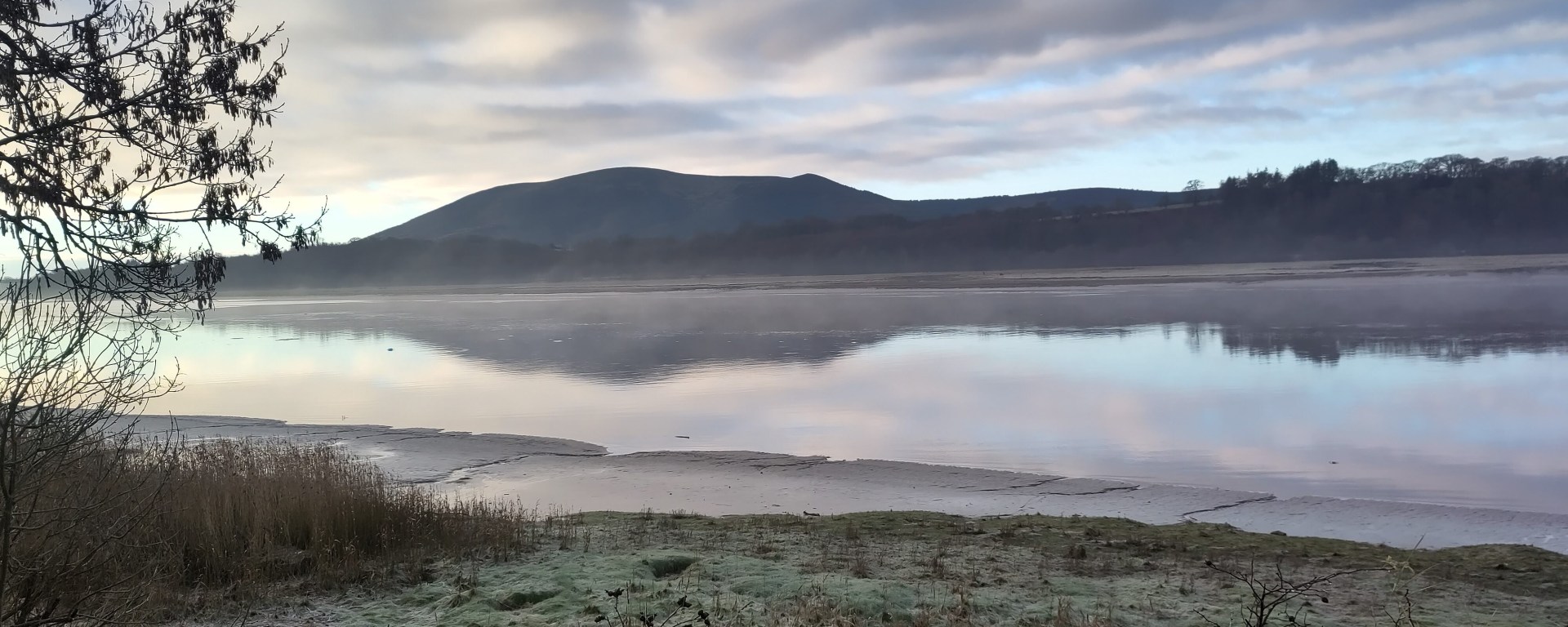
We’ve not been blessed with the most spectacular weather the last few weeks in the south-west corner of Scotland. In fact that’s more than an understatement: gale force winds knocked down our garden fence the other day, and our freestanding birdfeeder has been another polytrauma of the 60mph fringes of Storm Pia (which didn’t even register as a named storm in the UK; don’t get me started about Storm Gerrit, which came later).
But we had a break in the storm, a wee weather window, on Christmas Eve so, not confident of venturing too far away, we headed to the wildlife reserve to try to tick off one of our 2023 bucket list before the end of the year. We went in search of the bittern.

The Eurasian Bittern | photo credit: Richard Crossley, CC BY-SA 3.0 https://creativecommons.org/licenses/by-sa/3.0, via Wikimedia Commons
Bitterns are careful, secretive wading birds. They live and hunt in shallow water, hiding in reed beds. They have deep mascara streaks from cartoonish eyes and are famous for their characteristic booming sound, though I can’t say I’ve ever heard a recording that could convincingly be described as a ‘boom’. It seems to my ears more otherworldly than that, like a computer’s error message or a short clip of a vacuum cleaner swallowing something it shouldn’t have. Suffice to say, we were hoping to do more than just hear one. Birds are bolder in the hours after bad weather, when they’re hungrier and willing to take more risks.
The route from Dumfries to the WWT Natural Nature Reserve at Caerlaverock is a classic: brought to an international audience when it was paraphrased for the UCI Cycling World Championship para-cycling road race this summer, but even prior to that a poorly-kept secret among the Dumfries cycling community. It’s enjoyed for the scarcity of traffic, the gentle topography and most of all, the sprawling vista across the Nith estuary, a water awash with flighty flocks of warbling waders, lone herons and loping egrets. The Cumbrian hills beckon hazily on the horizon and all this is observed by the solemn and mighty Criffel, the summit of which is most often obscured by cloud. At the right time of year, the lowland pastures are saturated with colonies of overwintering geese (greylags, barnacles, and pinkfeet) and whooper swans. The birds feed on the grass by light and head out on to the sandbanks on the estuary to roost – safe from mammalian predators who would succumb to the quick sands – and their neat, noisy formations flitting low overhead between the two can be so frequent as to give the impression of living next to a Heathrow for wintering birds.

The UCI 2023 World Championship cycling para road race and time trial routes from Dumfries, Southwest Scotland. Route 2 is the abbreviated version of our beloved Caerlaverock loop | adapted from: https://www.traffic.gov.scot/uci-paracycling
The world champions turned off the coast road at Glencaple but we will continue, taking a detour through the woods round the back of Caerlaverock castle. Its’ name derives from the Gaelic word ‘laverock’, meaning skylark, and the ‘caer’ denoting a castle or nest; it holds the prestigious honour of being the only triangular castle in the UK. The woods boast a wide and sturdy gravel path which is suitable for all but the most spineless vanity-bikes (though you might have to hop off to get over the small lip at the start of the bridge). Then you’re back on the road and shortly down a private road, about a mile long, and with geese staring warily at you from all directions in their hundreds, until you arrive at the reserve, which has sturdy, covered cycle parking, very clean toilets and you can refuel with a bean-to-cup coffee in compostable cup, a packet of crisps or a flapjack, but little else. They used to serve a banging breakfast potato-scone roll but the café seems to have been a Covid casualty.
I could tell you all about the reserve but since this is a blog about cycling maybe I should stick to what I’m good at, and let you visit the place for yourself. Do visit though, it’s amazing at all times of year.

View across the salt marsh towards Caerlaverock WWT reserve | photo credit: Caroline Legg on flickr
After you’ve birded to bursting, twitched to your heart’s content, there’s a few different routes you can take back to town.
You could choose to close the loop and meet back with our elite para-cycling route on the high road, via Bankend, which is probably the shortest way back to Dumfries and you’re in charge after all, but can I counsel against it? That road is a drag: not in the sense that the hill is a killer but in the sense that it’s not endowed with inspiring landscape, being surrounded in all directions as far as the eye can see with flat open grazing land, mostly empty at most times of year. It’s also one of the most monotonously consistent low gradients I’ve ever cycled. It’s like Pythagoras himself built this road and it’s dull as hell.
Instead, I’d recommend coming back the way you came. In fact, if the weather is clement or you’re really feeling adventurous, the keen-eyed amongst you might have noticed a turn-off, just before the reserve, for a bird hide which is also accessible from the Caerlaverock wood. Take this turn to dodge potholes along a farm track for half a mile before committing to judder along a boardwalk with marsh and reed-beds on either side – not for the faint-hearted! – to Holland’s hide, a hut right on the merse but so out-of-the-way as to be equally likely in the middle of the end of the world.

The Rough Stuff Fellowship is a collaborative, est. 1954, of bicycle enthusiasts who considered no reach to far to be experienced with a two-wheeled companion. Does our merse raid make us eligible for membership? | photo taken from The Rough Stuff Fellowship Archive, Isola Press 2019
I said the weather had not been clement with us, and the strong winds pushing in from the estuary with nothing to hold them back certainly made this detour a bit of a Hairy Mary. Would my first encounter with a bittern be from a fish-eye view, after tumbling head-first off the boardwalk into its’ reedy bed? Fortunately not, for there were no tumbles but also disappointingly no bitterns either.
After the hide this route becomes a grassy path, slightly raised and cambered. We spent a good 15 minutes getting on and off the bike, pushing it at times through thick mud and lifting it over tree roots. This diversion is best appreciated after a series of warm and dry days, and with something substantially more than a spineless vanity-bike, but the rewards across the merse are outstanding.
BOOM!
Sunday 24 December, 2023
 Two Pedals
Most enjoyable. Your descriptions of the landscapes makes me feel as though I am there ❤️
Sent from my iPhone
LikeLike