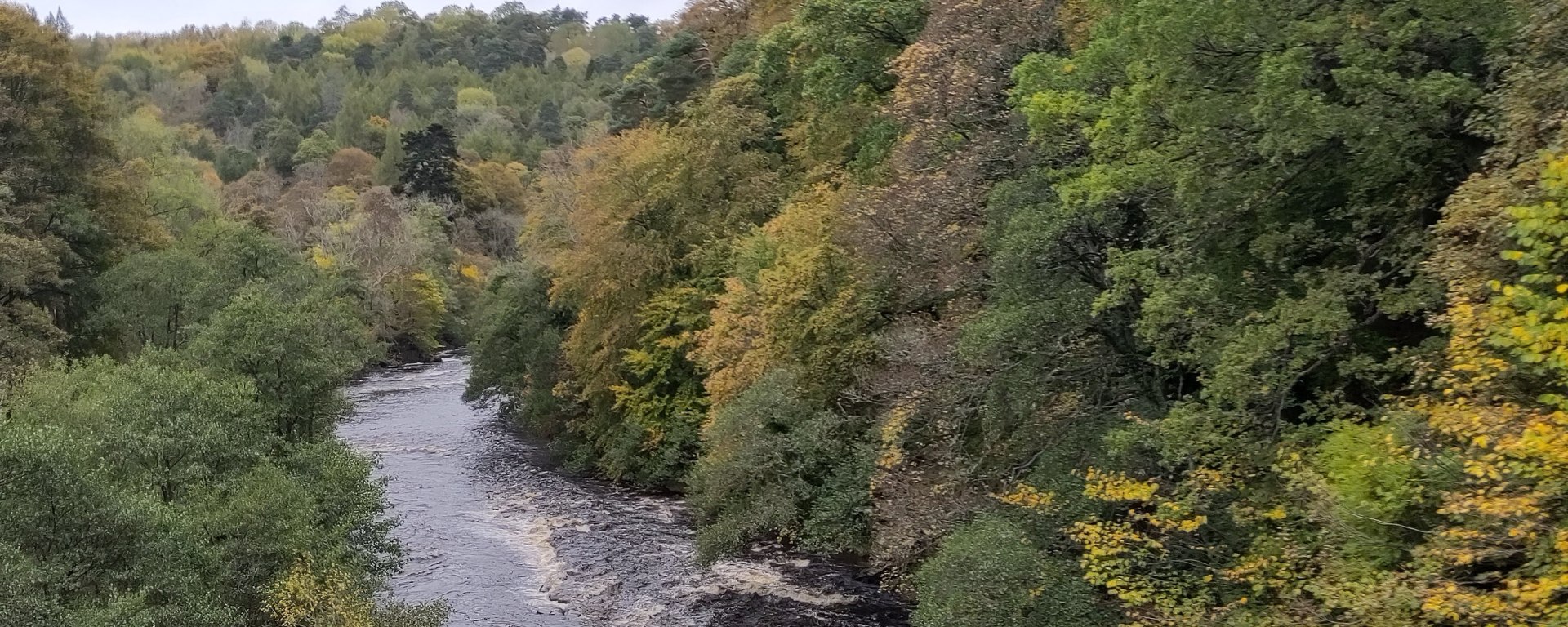
The most majestic and implausible pilgrimage of the animal kingdom must surely belong to the Atlantic salmon. From upriver spawning grounds, these eggs hatch into alevin, then undergo four metamorphoses in fresh water over one to three years before riding freshwater currents downstream to the sea. Out in the Atlantic they accumulate fat reserves, feeding on krill and small fish such as herring and sprats, until they are fit to breed. Then the most impressive chapter of their journey begins. The salmon locate the mouth of the river of their origin and head upstream, leaping over falls and other obstacles, barely eating as they battle strong currents, until they return to their place of birth to lay and fertilise eggs.
This is the journey we hoped to observe when we woke up in the morning and headed to Moffat with our bicycles. The best time to spot the leaping salmon is between October and November, just after a heavy rainfall. We was also retracing a magnificent journey by bicycle, between Moffat and Selkirk on the A708. Last time we embarked on this route was at the tail-end of winter, when tree boughs were bare and the cold air a familiar friend. This time we experienced the Moffat valley in the glory of autumn, when the forest declares its’ senescence in a blaze of fiery glory, broadcast loudly across the hillsides, screaming into the sky.
This is probably my favourite time of year to ride a bike. Maybe it’s because the days are getting shorter, reminding me that time, warmth and light are precious commodities that won’t be around for long.
Against a backdrop of fast-fading leaves, I was pinning my hopes that this journey would also be a rebirth of sorts for my bike adventures. I’ve been somewhat incapacitated by the unexpected expiry of Leo, my two-pedalled compatriot of 15 years. He’s been in my family since before I was born. Today was the inaugural proper scenic ride for my new steed.
The climb out of Moffat towards Grey Mare’s Tail waterfall was busy today. I’m out of condition with a lingering backache and a recently pulled hamstring but the gradient is not too savage, and I love counting the sheep on the roadside on my way up. They’re a languid bunch, quite unperturbed by the regular traffic. They’ve kept their long tails and it lends a doglike character to their movements and behaviour. Recently we acquired the fleece of a treasured sheep from a local animal sanctuary and spent several sacred hours plunging our fingers into its depths while we combed out the bugs and prepared it for milling, greasing our palms with delicious lanolin and breathing in a comforting smell equalled only by that of babies or puppies.
Whenever I recall riding this valley, I have tended to think mournfully of the scars by industrial forestry. While there was evidence of that acne on the valley steppes, I was pleasantly surprised that it seemed this time less overwhelming, and now counterbalanced by new tendrils of an emerging deciduous jungle called the Carrifran Wild Wood glowing shades of orange, yellow, red and gold, like a fire from which a phoenix might rise.
We stopped in the sunshine at the Glen Café at the interchange between Loch of the Lowes and St Mary’s Loch. Sitting on the veranda looking out at the loch, I recalled all the ways I might keep myself warm when the temperature drops – sitting with thighs pressed tightly together to seal in the heat, palms pressed against a mug of hot coffee, yogic ujjayi breathing, sidling up to a loved one.
The salmon ladder is at Philiphaugh, just shy of Selkirk, just behind a café called the Waterwheel. The visitor centre is a eulogy to the prowess of these impressive animals and the challenges these beasts overcome in their quest simply to exist and reproduce. It’s stark in its appraisal of the difficulties man has added into this journey, such as hydroengineering and climate change, in pursuit of our own ends. So it was with some sadness and surprise I discovered that the salmon ladder built to support this dwindling species was surreptitiously squeezed to the edge of an otherwise enormous river, 19 twentieths of which was occupied by a faceless concrete barrage to support a hydroelectric generator, which looked as though it would make mush of an adult salmon, eggs and all.
What an impossible journey for the salmon – there’s only a one-in-a-thousand chance that any given salmon egg will make it through all the obstacles, man-made and natural, to complete the cycle and return to its’ spawning grounds to breed again, before most likely dying, exhausted, shortly after, having travelled almost 4,000 miles in just a brief lifetime.
In my melancholy moments I pity these animals, genetically imprinted into a life of endurance and hardship, made nigh impossible by man’s steel-and-concrete monuments, which must seem utterly senseless to our more-than-human world. Perhaps this view of the salmon is diminutive though, perhaps it says more about my defeatist state of mind. Perhaps these resilient animals are cunning, and they arrive at these obstacles with a sense of curiosity. Perhaps they view them as a challenge, a chance to test what they’re made of, applying their deep ancestral knowledge of their native waters, and using it to their advantage. If I’m in a brighter state of mind I picture these magnificent fish, their strong bodies treading water at the base of a falls, analysing their environment, weighing up their options, preserving their energy and waiting patiently and knowledgeably for the right conditions to display their athleticism and complete their quest.
We didn’t see any salmon that day. Perhaps it had been too dry and the water was too low. We’ve been given some other places to try – up the Euchan river out of Sanquhar, at a point called Nurse’s Cross on the Mennock Pass to Wanlockhead, even at the weir on the Nith in the centre of Dumfries. We headed on to Selkirk, a town that we are cursed never to find the place we plan to eat open when we get there, but we are rescued yet again by the Peony Rose café.
This journey is easy to make from Dumfries or Carlisle by bike-friendly public transport. The X74 (Stagecoach) bus between Dumfries and Glasgow via Moffat has never let us down, with room for four bikes to be stowed comfortably below deck (though maxing this out is likely to jeopardise luggage space for other travellers). The Borders Bus X95 service from Selkirk (and many other Scottish Borders destinations) to Carlisle has dedicate space for up to two bikes (you can’t book in advance, and so far we’ve never been beaten to it by other bike-bussers, but it’s a risk). The good old ScotRail service from Carlisle to Dumfries (and often Glasgow) is now back up to full timetable and it is never a hassle taking your bike on this route, with space for at least six bikes, and no need to book.
Monday 14 October, 2024
 Two Pedals